Written for women tired of bracing for painful intimacy. See the 5 options compared

If Intimacy Has Started To Hurt, Read This Before You Try One More Lube Or Cream

Reviewed by Dr. Helena Marsh, PhD, Women's Intimate Health Research Lab
Updated June 12, 2026
Summary

For women who are tired of feeling dry, irritated, and bracing for painful intimacy. If you have been dealing with vaginal dryness, painful intimacy, or that constant feeling that things just do not work like they used to, this page may save you months of trial and error.

Most women are told to use more lube, try another cream, or wait it out. That sounds simple. It usually is not.

Spend the next few minutes here. You will see why so many fixes feel temporary, and which options women are turning to when they want more than a bandaid.

Why vaginal dryness is not just about the bedroom

Most people hear vaginal dryness and think it only shows up during intimacy. Wrong. For many women, dryness shows up all day. Walking. Sitting. Wearing jeans. Even a routine swab at the OB-GYN can feel uncomfortable.

That matters because the issue is not just lubrication in the moment. It is often a tissue health issue. When estrogen declines, or when hormones shift after menopause, postpartum, hysterectomy, certain medications, or even prolonged stress, the vaginal tissue can become thinner, less elastic, and less able to hold moisture naturally. That is why so many women say they feel like razor blades, or like crushed glass regardless of lubrication.

But here is the part most women never get told.

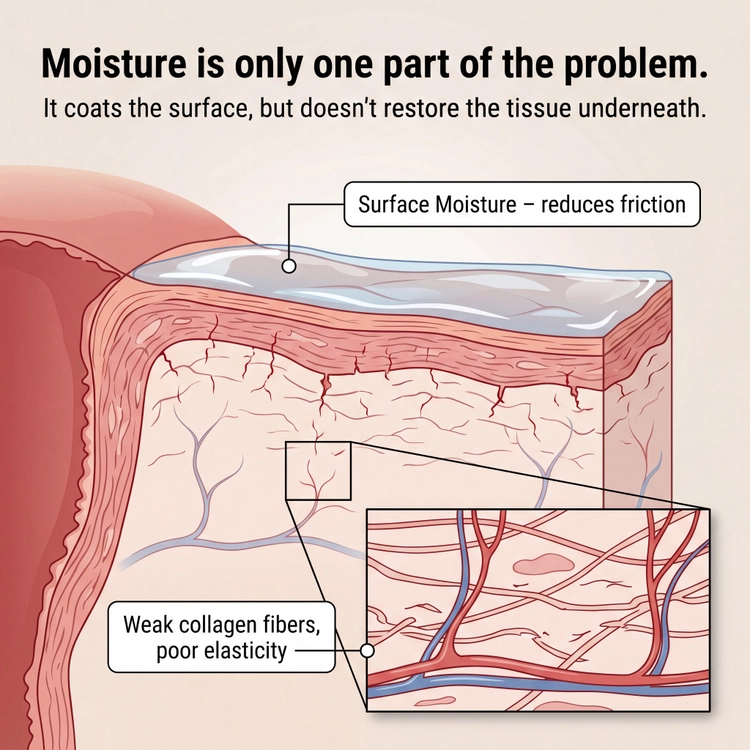
Moisture is only one part of the problem

A lot of products focus on adding moisture. That can help. But moisture alone does not always solve the whole thing. The tissue also needs circulation, elasticity, and resilience. Without that, you can still feel sore, fragile, or irritated even if you used a cream, a lubricant, or a suppository the night before.

In other words, surface moisture can reduce friction. It does not always restore the tissue underneath.

Now here is where most temporary fixes fall apart.

Why lube and creams can feel like a treadmill

Lube has a job. It reduces friction in the moment. But many women describe it as a pause-button solution. You stop, reach for the bottle, apply it, and hope it lasts long enough. Creams and inserts can help too. But women often complain about mess, slipping, leaking, residue, or the feeling that they are always managing the symptom instead of changing anything long-term.

It is not just that a product failed once. It is the pattern. Try something. Get partial relief. Run out. Symptoms come back. Buy again. Repeat. Monthly cost. Monthly effort. Same stress.

And for some women, the problem is even harder than that.

Some women cannot, or do not want to, use hormones

Hormonal support helps some women. That is real. But it is not the right fit for everyone. Some have a medical history that makes them cautious. Some hate the irritation. Some feel dismissed by doctors. Some just do not want another prescription layered into an already complicated routine.

That is a huge reason non-hormonal options matter. Not because hormones are bad. But because women need options that do not depend on another refill, another appointment, or another person taking the problem seriously first.

Who deals with ongoing dryness and painful intimacy

The 5 options women try, compared

They want relief that lasts longer than one night. Something that does not leave residue, does not make a mess, and does not make them feel broken. That is the standard the options below were judged against.

1

Lubricants

Lubricants are usually the first thing women try because they are easy to find, relatively inexpensive upfront, and designed for quick friction relief. In the moment, that can absolutely help.

How it works. Lubricants create a temporary slippery layer that reduces friction during intimacy. They are an event-based tool, not a tissue-support solution. They do not restore elasticity or change the underlying cycle that made dryness keep happening.

  • Reduces friction fast
  • Easy to buy without a prescription
  • Best when the issue is occasional, not persistent

Tradeoff. Helpful in the moment, but many women say it feels like a bandaid. Some dislike the interruption, the texture, or the fact that no amount of all natural lube could help once dryness became more severe.

Best fit forMild or occasional drynessShort-term help during intimacy

Now here is the option built for women wanting more than surface slip.

2
Best Pick

At-Home Red-Light Therapy Wand

This is where the category changes. Instead of coating the area temporarily, at-home red-light therapy is designed to support the tissue itself with a combination of dual-wavelength red light, gentle therapeutic warmth, and sonic micro-vibration. In plain English, it is aimed at the stuff underneath the symptom.

✨ AI match · found in this article The non-hormonal device referenced above
★★★★★
Non-hormonal. One-time purchase. No refill treadmill.

Support beyond temporary lubrication.

660nm + 662nm red-light therapy, controlled gentle heat, and low-amplitude sonic stimulation in one at-home format. Designed to support natural lubrication, circulation, tissue comfort, and pelvic-floor response.

See How Red-Light Therapy Works At Home
90-Day Risk-Free Guarantee

Why that matters. Most alternatives help with moisture only. Red-light therapy is the only option in this comparison built to address natural lubrication, pelvic-floor strength, and tightness in one non-hormonal at-home format.

  • Non-hormonal by design
  • One-time purchase instead of monthly refills
  • Includes pelvic-floor tightening and strengthening support
  • No doctor visit required to get started
  • Discreet, private use at home

Support layer. The better at-home programs also give you access to real intimate-wellness experts who join your journey to advise you at no extra cost, which matters for women who felt rushed or dismissed elsewhere.

Best fit forMenopause and perimenopausePost-hysterectomy or postpartumMedication-related dryness

Of course, some women still prefer a more familiar route first.

3

Vaginal Creams And Suppositories

Creams, gels, and suppositories are common because they can deliver moisture directly where the dryness is happening. For some women, they work well enough to make intimacy more comfortable for a day or two.

How it works. These products add localized moisture or comfort through topical application. Some women like that they are targeted and do not require swallowing anything. Others report fast relief, less burning, and easier intimacy after use.

  • Direct localized use
  • Can help with short-term moisture and comfort
  • Useful when dryness is the main issue

Tradeoff. Leakage. Mess. Slipping out. Residue. Timing around bedtime or intimacy. Some women say they worked, but felt cumbersome enough that they wanted an easier long-term option.

Best fit forWomen comfortable with insertsOkay with repeat use

And then there is the option many women are skeptical about at first.

4

Oral Supplements For Vaginal Moisture

Supplements have become popular because they feel simple. Take the capsule. Let it work from within. No cream. No insert. No bedside routine.

How it works. These products typically aim to support moisture, comfort, libido, or hormonal balance through daily internal supplementation. Some women report noticeable changes in dryness, comfort, confidence, and even desire after several days or weeks.

  • Easy daily routine
  • No mess or insert
  • Often chosen by women who want a hormone-free approach

Tradeoff. Results can vary, and some women need continuous use to maintain benefits. There is also the refill issue. Stop buying, stop taking, and the support may stop too.

Best fit forWomen open to supplementsWilling to take something daily

Last, there is an option that matters when pain is not just dryness.

5

Pelvic Floor Physical Therapy And Internal Tools

For women whose pain is connected to deep pelvic tension, tightness, or post-birth changes, pelvic-floor work can be a real unlock.

How it works. Pelvic-floor PT and internal tools aim to release tight muscles, reduce spasms, and improve body awareness. For some women, that relief is dramatic, including help with abnormal tightness and posterior muscle spasm that standard exercise routines did not solve.

  • Targets muscular pain and tension directly
  • Can help when intercourse pain is linked to tight pelvic muscles
  • Especially useful postpartum or after chronic pelvic pain

Tradeoff. It can be highly effective for the right issue, but it does not replace the need for moisture support if dryness is still the main driver. It is also a heavier lift than an at-home device routine for many women.

Best fit forPelvic pain or tightnessMuscle-related discomfort beyond dryness

The standard women are actually judging against.

Relief that lasts longer than one night. Intimacy that stops feeling like a negotiation with pain. No residue, no mess, no perfect timing, and no feeling broken. Of the five, only one was built to address natural lubrication, pelvic-floor strength, and tightness in a single non-hormonal at-home format.

See How Red-Light Therapy Works At Home

Join the discussion

22 comments
Carin L.· 2d ago

By 47 I had gotten to the point where I was actively avoiding my husband because sex felt like razor blades, and that is not me being dramatic. We tried every lube in the bathroom drawer, different brands, more of it, less of it, all the "relax and have a glass of wine" advice, and I still dreaded bedtime. It messed with my head more than I expected. I felt old overnight. I found this wand when I was rage googling at 2 a.m. and figured fine, one more thing. Nothing magical happened the first few uses, but after about 3 to 4 weeks I noticed I wasn't bracing as much, and by the second month I actually wanted intimacy again instead of planning excuses. My only gripe is the one cost up front felt big, but honestly it ended up being less than the pile of creams and random supplements I kept buying.

47perimenopausepainful sex
A
Amber D.· 3d ago

For anyone reading these comments at 1 in the morning and feeling weirdly ashamed, I was there too after my hysterectomy put me into surgical menopause. The dryness was bad, but the part nobody talks about is how it tanks your confidence and then your libido follows right behind it. I tried the little suppositories and creams for months. Half the time they leaked, or I'd have to plan bedtime around them, and I was over the whole monthly refill routine. I wanted something non hormonal because that route wasn't a fit for me. This device was slower than I wanted, full honesty. First couple weeks, basically nothing. Then around week 4 I started noticing less irritation day to day, and intimacy stopped feeling like this looming stressful event. It is not instant, but so far it has felt more sustainable than chasing temporary moisture.

post-hysterectomynon-hormonal
A
Jill M.· 1d ago

finally something that doesn't require a mid moment scramble for the lube bottle. took me around 3 weeks, tbh.

A
Renee K.· 4d ago

ok but is the light actually doing anything, or is this basically an expensive vibrator with an LED slapped on it? genuinely asking.

Patrixia A.· 4d ago

I wondered the same thing. From what I understand, the vibration is more for comfort and blood flow, but the red light is the part aimed at the tissue itself. For me it felt different than just using a regular toy, especially after a few weeks.

Renee K.· 3d ago

that actually makes more sense, thank you. skeptic brain is still on, but less on fire lol

A
David W.· 5d ago

Husband here. My wife is 52 and four gynos basically told her "use lube" or "have some wine," which made her cry in the car. Is this kind of at home thing actually worth looking at if she does not want hormones?

Theresa K.· 5d ago

I got the same brush off at 50 and it was brutal. If hormones are off the table, a non hormonal device you can use privately at home is at least something different from the endless lube advice. It was the first thing that felt like it was addressing more than the moment itself.

A
anonymous· 6d ago

i'm 23 and this is so embarrassing to even type. i'm very attracted to my partner but still dry and then it hurts, so then i get anxious and feel broken. i literally thought this was only a menopause thing?

Sarah B.· 5d ago

You're not broken. It is way more common than people admit, even younger, with stress, meds, birth control, anxiety, a bunch of stuff. The nice thing about this kind of device is it's non hormonal, so you don't have to fight for a prescription just to try something.

anonymous· 5d ago

thank you. still nervous because i'm only 23, but honestly i'm willing to try anything that doesn't make me feel defective.

A
Virginia C.· 6d ago

how is this different from the suppositories and creams? those do help a little but i'm so tired of the leaking, residue, and timing it before bed.

Indira F.· 6d ago

That was exactly why I switched. Creams gave me temporary surface moisture, which is fine but messy. This red light thing is trying to help the tissue itself, and there is no nightly insert, no slipping out, no weird residue on pajamas.

A
JC H.· 7d ago

can someone be real about whether this is worth it? not cheap, and i'm already spending money every month on creams and random menopause supplements. also is it discreet?

Ms. Lo· 6d ago

Real answer, the one cost up front made me wince too. But I did the math after 6 months and realized I had been rebuying creams, moisturizers, and gummies constantly. This was one purchase instead of a monthly stream of stuff, so for me it evened out.

JC H.· 6d ago

helpful. last practical question, is it actually quiet/private? i have zero interest in explaining anything to my teenagers.

Ms. Lo· 6d ago

Yes, pretty discreet. It does not sound loud in my experience, more of a soft hum, and it just looks like a personal care device. I keep it in a toiletry bag in my bathroom drawer and nobody has ever noticed.

A
Ashley P.· 4d ago

in the middle of trying to figure this out because my antidepressant plus allergy meds have basically turned everything into the sahara. can't add hormones. is there even a non hormonal option that isn't just "more lube"?

Michelle R.· 4d ago

I was in almost the exact same boat, SSRI plus antihistamines, and lube was only helping for five minutes. I went the wand route because it was non hormonal and private. It took a few weeks, but it felt more useful than just layering on another product.

A
Jessica P.· 5d ago

mine feels like more than dryness. after my second baby I have tightness and pelvic floor tension, so intimacy hurts even when i'm not technically dry. does this help that too or only dryness?

Michelle T.· 5d ago

For me it helped both. The moisture part was one thing, but the gentle warmth and vibration also seemed to help me unclench, and my PT said better tissue health can matter for pelvic floor tightness too. Not a replacement for pelvic floor therapy if you need it, but not only about lubrication.

Jessica P.· 5d ago

that is actually the answer I needed. i'm doing PT already, just wanted to know if this was pointless for my version of the problem.

A

Add your comment

A
Your comment has been posted successfully. It will be shown to others shortly.
✨ AI match · found in this article
Flowra Wand
The non-hormonal device mentioned above
See how it works